Wednesday, April 5, 2017

Rain Barrels Now Legal in Colorado

Photo by Carol King

As of Aug. 10, 2016 House Bill 16-1005 became law,  allowing most Colorado  home owners to use up to two 55-gallon barrels to collect rainwater from their rooftop downspouts. This spring appears to be a rainy one, so as a homeowner you might want to try your hand at capturing rainwater.  There are some caveats however so read the bill carefully before deciding to install barrels.

Highlights of the law are as follows:
1. Homeowners may use rain barrels to collect rainwater at single-family households and multi-family households with four (4) or fewer units.

2. A maximum of two (2) rain barrels can be used at each household and the combined storage of the two rain barrels cannot exceed 110 gallons.

3. The captured rainwater must be used on the same property from which the rainwater was captured, for only outdoor purposes, including to water outdoor lawns, plants and/or gardens.

4. Rain barrel water cannot be used for drinking or other indoor water uses.

5. House Bill 16-1005 requires the container to be equipped with a sealable lid.

6. Watering plants in a greenhouse where such a building is specifically dedicated to growing plants is NOT allowed. 

It is important for rain barrel users to understand that the capture and use of rainwater using rain barrels does not constitute a water right. The State Engineer will deliver its first report on rain barrels sometime in 2019 and if a water right holder can prove that those rain barrels have impacted their ability to receive the water that they are entitled to by virtue of their water right, rainwater collection will be curtailed.

Other considerations for the homeowner who choses to capture rainwater and use it in the landscape include the following cautions:
  • Untreated rainwater collected from roofs is not safe to drink, due to concerns surrounding microbial contamination of harvested rainwater. 
  • Because of the infrequency of rainfall there can be an accumulation of bird droppings, dust and other impurities on rooftops between rain events. Roofing materials, pitch, and heavy metals such as cadmium, copper, lead, zinc, and chromium may occur in high concentrations when it does rain. 
  • Acid rain can also cause chemical compounds to be leached from roofing materials.
  • Filtering  and screening out contaminants before they enter the storage container can help to mitigate this problem. Dirty containers may also become a health hazard or a breeding ground for insects and other pests.
For complete information on use of rain barrels in the state of Colorado, please refer to Colorado State University’s Fact Sheet. http://tinyurl.com/CSU-rainwater
The complete House Bill can be found here: http://tinyURL.com/rainwater-bill


Sunday, April 2, 2017

Spring Planting? Add Some Natives to Your Landscape! by Donna Duffy

Pulsatilla patens, Pasqueflower, blooming on the first day of spring, photo by Donna Duffy
There is a growing trend among Colorado gardeners to incorporate native plants, trees and shrubs into their landscapes. Indeed, in some areas, native plantings may be required by law, covenant or policy. There are so many good reasons to include native plants in the landscape! They attract pollinators, butterflies and birds, they are adaptable to poor soil, and they typically require less water. 

Saturday, April 1, 2017

Happy April Fools' Day by Carol King

punjabigraphics.com
Did you ever wonder where this silly holiday came from?  Also called All Fools’ Day, it has been celebrated for several centuries by different cultures, but its exact origins remain a mystery.

 Some historians speculate that April Fools’ Day dates back to 1582, when France switched from the Julian calendar to the Gregorian calendar, as called for by the Council of Trent in 1563. People who were slow to get the news or failed to recognize that the start of the new year had moved to January 1 and continued to celebrate it during the last week of March through April 1 and became the butt of jokes and hoaxes. It became a popular holiday in 1700 in England when pranksters begin  playing practical jokes on each other. 

April Fools’ Day has also been linked to ancient festivals such as Hilaria, which was celebrated in Rome at the end of March and involved people dressing up in disguises. 

My favorite speculation and the one that is so appropriate to Colorado is the conjecture that April Fools’ Day was tied to the vernal equinox, or first day of spring in the Northern Hemisphere, when Mother Nature fooled people with changing, unpredictable weather. We have certainly have had our April Fools’  from Mother Nature!

In any event, if you receive a packet of these, dear gardener, enjoy! 


Monday, March 27, 2017

Controlling Mullein in Your Landscape By Joyce D’Agostino

Common Mullein, photo courtesy Common Sense Homesteading
Last year I was surprised to find a plant volunteering in one of my raised beds that had some unusual features, including a tall spire that had small yellow flowers. In addition it had thick and very soft fuzzy leaves. I learned that this plant is the Mullein, Verbascum thapsus. This plant goes by several common names including flannel leaf and can be found in fields, pastures, along roadsides and even in your garden. 

Friday, March 24, 2017

Pre-Emergent Herbicides by Donna Duffy

Dandelion, photo courtesy extension.usu.edu
March is the time of year to consider the application of pre-emergent herbicides. Planttalk Colorado provides the following information and guidance. 

A pre-emergent herbicide does not prevent weed seed germination or kill the seed. Instead, the root system development of a young weed seedling is severely limited by the action of the pre-emergent herbicide, killing it before it “emerges” preventing the weed from establishing. Pre-emergents will not control existing weeds, but will, if applied before germination, control seedlings of annual or perennial weeds.

Tuesday, March 21, 2017

Planting Pansies and Violas by Carol King

It's not too early to start adding color to your yard.  Plant pansies and violas now. They are hardy little flowers and don't mind a late snow! The video talks about planting in the fall, but the same techniques apply for spring planting.

Saturday, March 18, 2017

Get Your Soil Test Before You Start Planting by Donna Duffy


Most of us take our soil for granted, and don’t give too much thought about it until it’s time to plant. Even then, it’s easy to dump a bag of compost on the planting site and walk away thinking that we’ve done our soil a big favor. Not so! Soil is a dynamic living substance in which complex biological and chemical reactions take place every day. Taking time to learn about the soil in your yard is one of the best things you can do to maximize the success of your landscaping efforts.

Before planting that new garden, get a soil test! Photo by Donna Duffy

Friday, March 17, 2017

Happy St. Patrick's Day!

Photo courtesy dotcomwomen.com

Wednesday, March 15, 2017

History of the Irish Shamrock by Carol King

Photo courtesy CSU
The Irish shamrock (Irish: seamrog) is the most recognized symbol of the Irish. It has been symbolic of many things through the years. It was considered to be a sacred plant to the Druids of Ireland because its leaves formed a triad, and three is a mystical number in Celtic religion as well as many other religions. Supposedly, St. Patrick used it to illustrate the Holy Trinity to help convert Irish peoples to Christianity. 

In Ireland, all shamrocks are considered lucky and are worn and given as gifts on St. Patrick's Day. However, there is some disagreement among the Irish as to the exact plant, but most Irish growers will tell you that Trifolium repens, White Clover, is the plant most commonly known as a shamrock.   What we consider to be a common lawn weed, is a native of Ireland.  In Colorado, this Irish shamrock grows in our lawns, in prairies, pastures and foothills. If you enjoy clover honey, you can thank this lovely little plant.

Tuesday, March 14, 2017

Choosing the Best Seed for Your Vegetable and Flower Garden by Joyce D’Agostino

Early Tomato "Glacier",  photo courtesy territorialseed.com

By now many of you have been receiving seed and plant catalogues in the mail and the retail stores have racks of seeds beaconing you to bring them home.

Before you make your purchases, here are a few tips to help you choose the best seed for your garden for best results.

Saturday, February 25, 2017

Create Your Own Apple Tree by Mari Hackbarth

1909 Illustration of a "Colorado Orange" Apple,  USDA

What kind of apple trees do you think Johnny Appleseed planted as he sowed swaths of seeds to establish orchards across the Midwest?  It turns out that every seed he planted grew into a unique apple tree!  Planted apple seeds will not produce a tree or fruit exactly like the original fruit or tree the seed was collected from.  If you grow an apple tree from a Macintosh apple seed, you will have an apple tree, but not a Macintosh apple tree.  Apples are an example of a plant that can only be reproduced exactly by a technique known as “grafting”.  Grafting is the process of joining two plants together.  The upper part of the graft (the scion) becomes the top of the resulting plant, and the lower part provides the root system.

Thursday, February 23, 2017

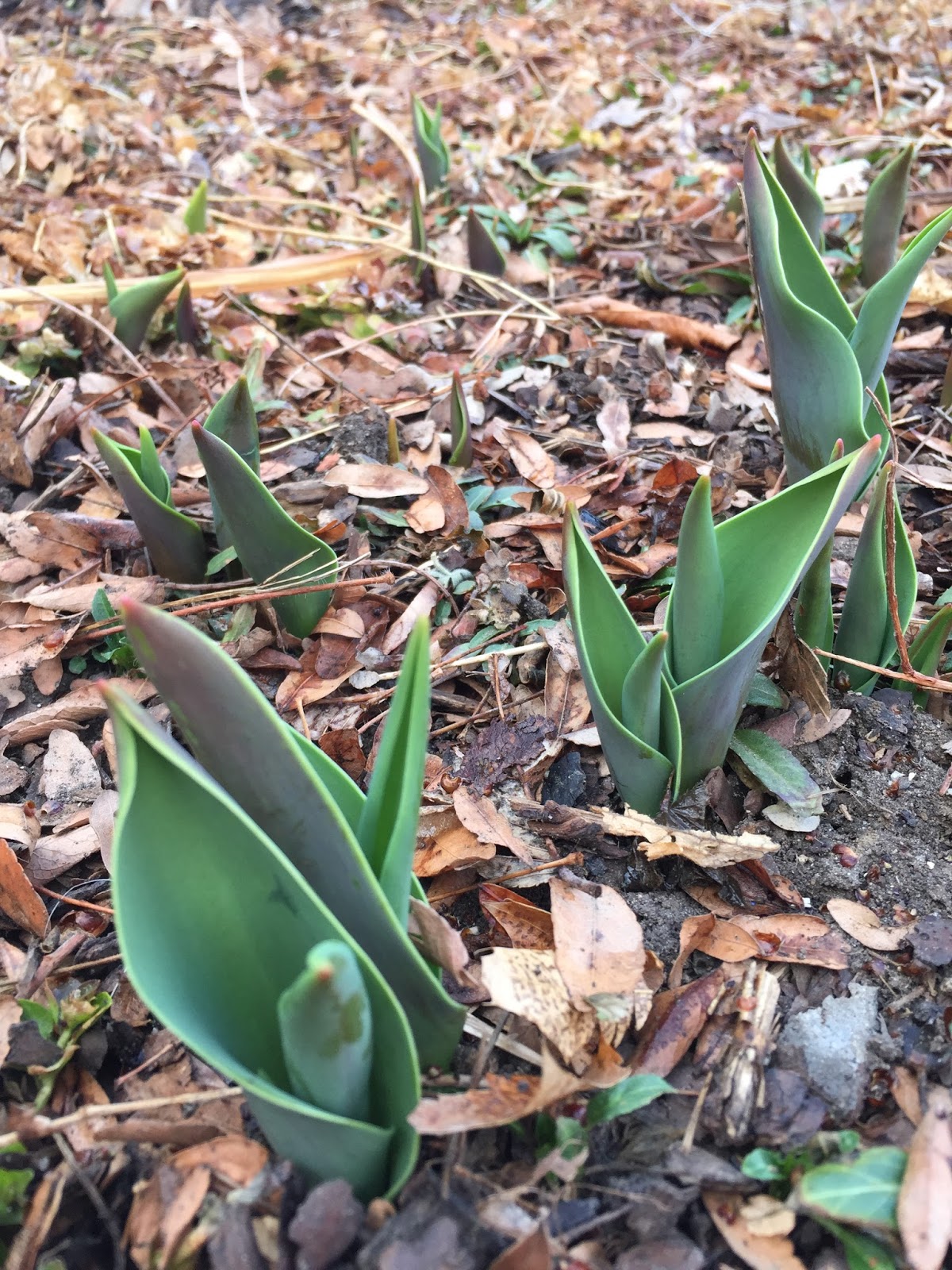
Tulips Emerging Early by Donna Duffy


Late season tulips emerging in February, photo by Donna Duffy

This recent surge of warm weather has created conditions for some spring-blooming bulbs to emerge early. You’ve probably noticed crocus blooming, especially if they are near a wall or rock. Crocus are tough, low-growing flowering bulbs, and can tolerate snow and cold. I also noticed that some of my late-season tulips  have just broken ground, and that is more unusual. Here are some tulip tips for late winter from Ron Smith, Horticulturalist at the North Dakota State University Extension Office.