Thursday, March 17, 2016

A Celebration of Irish Plants by Donna Duffy

Trifolium repens, Photo courtesy backyardgardener.com

You probably know that in Ireland, all shamrocks are considered lucky and are worn and given as gifts on St. Patrick's Day. Most Irish growers will tell you that Trifolium repens, White Clover, is the plant most commonly known as a shamrock. In Colorado, this Irish shamrock grows in our lawns, in prairies, pastures and foothills. If you enjoy clover honey, you can thank this lovely little plant.

Monday, March 14, 2016

Rethink Your Lawn by Donna Duffy


Photo courtesy university-gardens.com
Across Jefferson County, bluegrass lawns are just starting to green up. This is a good time to think about changes you’d like to make in your lawn this year. There are at least three options to consider:
  1. Leave it pretty much as is
  2. Renovate it
  3. Remove some lawn for vegetable or flower plantings

Saturday, March 5, 2016

The Importance of Insect Pollinators by Audrey Stokes

Bumblebee
First things, first: What are pollinators?

Many insects, birds, and animals help move pollen between flowers and act as “pollinators”. Butterflies, moths, bees, wasps, and flies are examples of insect pollinators. When a pollinator visits a flower it is looking for food but while feeding, these insects inadvertently transfer pollen grains between flowers and help the plants produce fruit and seeds.

Next: Why is pollination important to plants?

Pollination is important because it leads to the production of fruits we can eat, and seeds that will create more plants. Pollination begins with flowers. Flowers have male parts that produce very small grains called pollen. Pollination is the transfer of pollen grains from one flower to another.

And, so: What are the importance of insect pollinators?

Pollen Wasp
  • Pollinators support biodiversity: There is a correlation between plant diversity and pollinator diversity.
  • The pollinator population of an area is a great indicator of the overall health of an ecosystem.
  • Some crops, including blueberries and cherries, are 90 percent dependent on honey bee pollination.
  • Honey bees visit five million flowers to make one pint of honey.
  • To produce 150 pounds of honey, bees cover a distance equal to 13 trips to the moon and back.
  • 90 percent of the nation's apple crop is pollinated by bees.
  • There are 4000 bee species in the U.S. 
  • Increased yields and higher quality crops are benefits that growers and consumers realize from a healthy pollinator population, native or managed.
  • Worldwide, approximately 1,000 plants grown for food, beverages, fibers, spices, and medicines need to be pollinated by insects and animals in order to produce the goods on which we depend.
  • It’s estimated that there are about 2.4 million bee colonies in the U.S. today, two-thirds of which travel the country each year pollinating crops and producing honey and beeswax.

Thursday, February 25, 2016

What is an Insectary? By Joyce D’Agostino

Photo by Joyce D'Agostino
We are all aware now that some benefical insects like the honeybee are endangered and need to be protected and nurtured. Some areas are dedicating space to growing plants that attract beneficial insects but for the home gardener, we may not have large spaces of land just to dedicate to this effort. Some may also feel they want less bugs, not more in their garden but the key is finding the right plant for the right place in your garden to bring in the ones that are helpful rather than harmful.

 The good news is that you can do a smaller scale insectary in your own garden and landscape by following a few guidelines. You will first need to select seeds and plants that will bring these insects into your garden. One step would be to research native plants for your area. This helps you attract the insects that are also native to your area. These garden notes publications will help you choose some of these plants: http://www.ext.colostate.edu/mg/Gardennotes/582.html http://extension.colostate.edu/topic-areas/yard-garden/wildflowers-in-colorado-7-233/ 

Sunday, February 21, 2016

Growing Grapes for Wine? It's Time to Prune! by Donna Duffy

John Crawford, photo by Donna Duffy

My neighbor, John Crawford, is a fourth generation vintner. I recently asked him to share some advice on pruning vines for maximum grape production. Here’s what I learned.

Saturday, February 6, 2016

Celebrate the Super Bowl! by Donna Duffy

Look no further than the world of plants to boost your 
Super Bowl fever!

Victory Rose
Photo courtesy direct gardening.com

Wednesday, February 3, 2016

Solving Low Humidity Problems in Houseplants by Carol King

Prayer Plant (Maranta leucoreura) photo by Carol King

This time of year, we Colorado gardeners turn to indoor plants to soothe our gardening souls.  However the indoor environment in our homes can be very harsh for many plants. Many of our house plants are native to humid, tropical rain forests and require special consideration when they reside in our Colorado homes. While lighting and temperatures need to be monitored for successful indoor gardening, humidity is the big issue during colder months.  Heating systems common in Colorado circulate dry, warm air throughout the house. Our indoor environment often has less than 10 percent humidity. This is a drastic reduction from the 70 to 90 percent relative humidity levels found in the native climates of most tropical plants.

Monday, February 1, 2016

JeffCo Colorado Master Gardener Speakers Bureau: Master Gardeners in Service by Sally Berriman

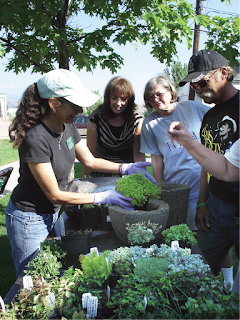
Master Gardener show proper planting techniques
Need a great speaker for your next meeting?  Colorado State University Extension in Jefferson County may have just the person that you are looking for.  The Speakers Bureau is a group of CSU Extension certified Colorado Master Gardener volunteers who have received additional training to talk to groups on various horticultural/gardening topics.  Master Gardeners are available to give talks to garden clubs, neighborhood associations, fraternal organizations, schools, businesses or church groups. 

All of our speakers provide scientific, fact-based information on the best horticultural practices for Front Range gardeners.  There are various speaker styles available; we give lectures with or without slide presentations, demonstrations, hands-on classes as well as panel discussions.  We speak in classrooms, living rooms or backyards.

Saturday, January 30, 2016

Landscaping With Colorado Native Plants Conference

Pulsatilla patens, photo courtesy Donna Duffy
Come to Loveland on Saturday March 12th for the first conference of its kind in Colorado! It's the perfect antidote to a gardener's winter blues.  Here are the details:
8:00am - 5:00pm
The Ranch Event Complex
Larimer County Fairgrounds, Loveland

Breakout Sessions include information on:
  • Designing with Natives
  • Construction of Native Landscapes
  • Micro-Climates
  • Edible and Medicinal Native Plants
  • Native Plants for Every Situation
  • Habitat Gardening
The Keynote Speaker, Susan Tweit, will present "The Ditch and the Meadow: How Native Plants and Gardeners Revived a Neighborhood and Changed the Culture of a Town."
Click here for more information and to register. See you there!

Thursday, January 28, 2016

Master Gardeners in Service: A New Blog Series

Engaging a new generation of gardeners!
In 2016, the Jefferson County CSU Extension Colorado Master Gardeners are proud to be celebrating our 40th anniversary of service to Jefferson County residents.  Jefferson County has one of the largest cadres of Master Gardeners in the state – over 100 currently. These volunteers utilize research-based information to foster successful gardeners, develop partnerships and build strong communities. 

To celebrate our 40th anniversary, we are publishing a series of blogs titled Master Gardeners in Service. We will highlight the many ways that Master Gardeners interact with Jefferson County residents and offer opportunities for you to engage with us individually or at a community event.

We invite you to click on our Master Gardeners in Service series link often! We will be adding articles every month during 2016. Join us in celebrating our 40th anniversary!


Sunday, January 24, 2016

Cleaning Your Garden Tools by Donna Duffy

Photo courtesy country file.com
Gardeners tend to get the mid-winter blues this time of year. Summer seems so far away! We nourish our gardening souls by looking through seed catalogues, feeding the birds, reading our garden journals from last year. But there are some gardening tasks that can be done now so you'll be ready when the ground thaws and the first shoots of spring appear.

Friday, January 22, 2016

Flowers Succesfully grown on the International Space Station By Joyce D’Agostino

Astronaut Scott Kelly's Twitter Post
This week some exciting news came from the International Space Station. An experiment to grow zinnia flowers was successful and resulted in the plants sprouting, growing and then producing bright flowets.  
Here on earth, Zinnias are know as one of the easiest and hardiest flowers to grow. But according to the following article, there were some challenges including  too much and too little humidity and of course trying to get plants to sprout and keep stable in the absence of earthly gravity.
Unlike some of the vegetables they have successfully grown such as Romaine Lettuce, the flowers needed more attention to get them to grow as a healthy plant without disease or other problems. The flowers also took more time to grow and develop compared to lettuces. An additional interest with this flower is that it is edible.
The “Veggie Lab” is planned to be an ongoing experiment onboard the Space Station with goals to be able to produce fresh food for the astronauts.
This is the second flower to be tested and grown on the ISS, the first was a small sunflower. The variety of the Zinnia grown on the ISS is Zinnia hybrida “Profusion”. The seeds are readily available from a number of seed companies.